

MIPS 2027 Updates: A Practical Guide for Clinicians, Practices, and Office Managers

MIPS 2027 Updates: A Practical Guide for Clinicians, Practices, and Office Managers | TriumpHealth
The Centers for Medicare & Medicaid Services (CMS) has finalized significant changes to the 2027 Merit-based Incentive Payment System (MIPS), introducing new Quality reporting requirements, expanding MIPS Value Pathways (MVPs), and updating Promoting Interoperability policies.
For healthcare providers, independent medical practices, and office managers, understanding these changes is essential to maintaining Medicare compliance, improving MIPS performance scores, and protecting future Medicare Part B reimbursements.
The 2027 MIPS Final Rule also establishes a clearer timeline for transitioning away from traditional MIPS reporting, making early preparation increasingly important. Here is a practical breakdown of the most important MIPS 2027 updates, their impact on medical practices, and the steps providers should take to prepare.
1. MIPS 2027: What Clinicians and Practices Need to Know
MIPS is part of the CMS Quality Payment Program (QPP), which promotes healthcare quality, efficiency, patient safety, and value-based care. Eligible clinicians are evaluated across four performance categories:
| MIPS Performance Category | Standard Weight |
| Quality | 30% |
| Cost | 30% |
| Improvement Activities | 15% |
| Promoting Interoperability | 25% |
| Total | 100% |
Category weights may change for clinicians or practices qualifying for special-status adjustments or approved reweighting.
Key MIPS 2027 dates and requirements:
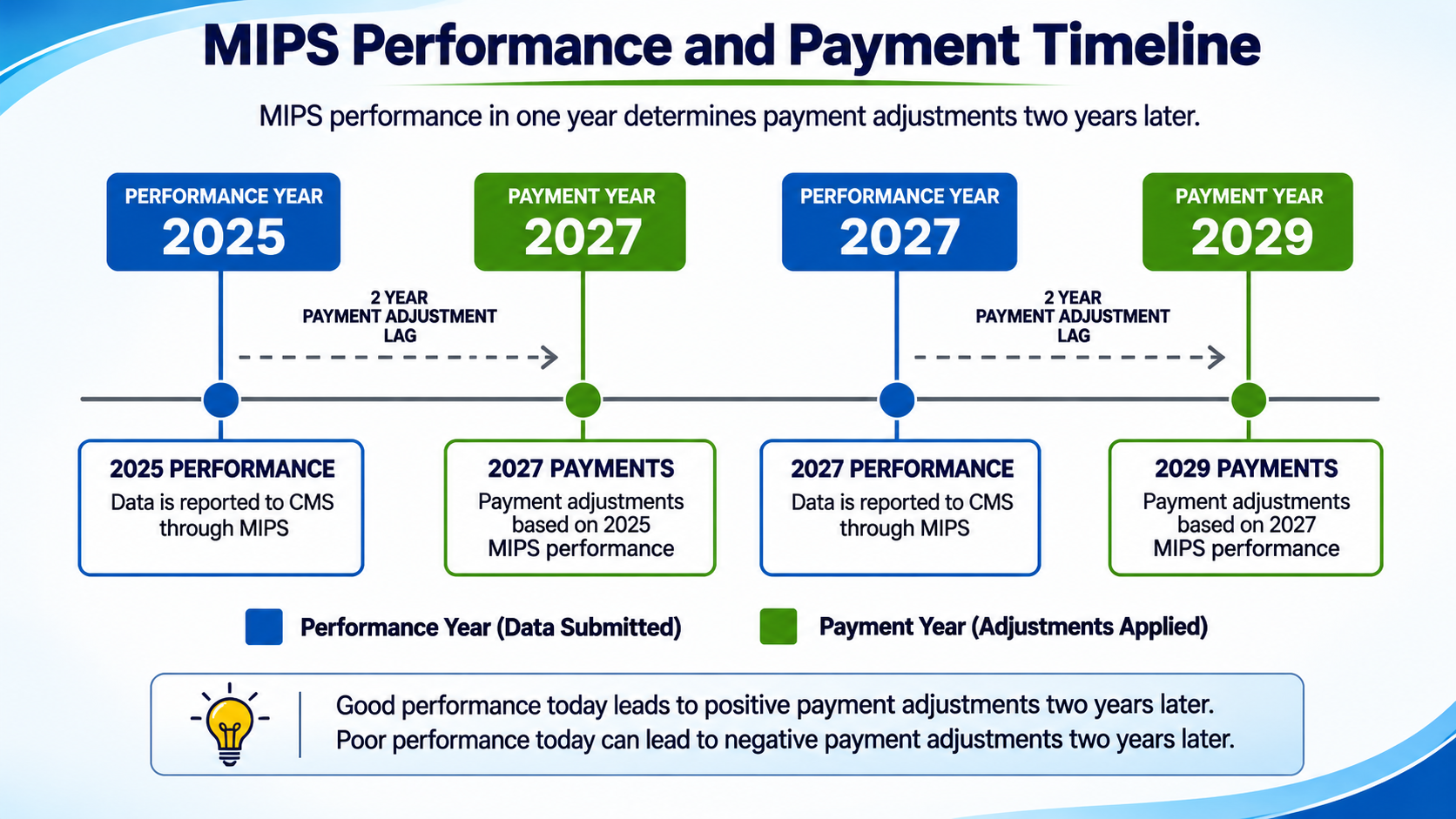
- Performance Year: January 1–December 31, 2027
- Data Submission: 2028, during the CMS-designated reporting period
- Medicare Payment Adjustment Year: 2029
- MIPS Performance Threshold: 75 points
- Quality Data Completeness Requirement: 75%
- Maximum Negative Payment Adjustment: 9%
- Traditional MIPS Sunset: Beginning with the 2031 performance year
These requirements emphasize the importance of proactive performance monitoring, appropriate measure selection, and accurate reporting.
2. MIPS Performance Threshold Remains at 75 Points
CMS has maintained the 75-point MIPS performance threshold for the 2027 performance year. A clinician’s final MIPS score determines the Medicare Part B payment adjustment applied in 2029.
| Final MIPS Score | Payment Impact |
| Below 75 points | Negative payment adjustment |
| Exactly 75 points | Neutral payment adjustment |
| Above 75 points | Positive payment adjustment, subject to budget neutrality |
The maximum negative adjustment remains -9%.
However, scoring above 75 points does not guarantee an equivalent percentage increase in Medicare reimbursement. Positive adjustments depend on CMS budget-neutrality calculations.
What practices should do: Rather than targeting the minimum 75-point threshold, clinicians should develop a reporting strategy that provides a comfortable performance margin.
Quarterly reviews of Quality performance, Cost feedback, Improvement Activities, and Promoting Interoperability can help identify potential scoring weaknesses before the end of the performance year.
3. New MIPS Core Measure Requirements Begin in 2027
One of the most significant changes for 2027 is the introduction of MIPS Core Measures.
Beginning with the 2027 performance year, most applicable clinicians must report at least one designated Core Measure within their required Quality measures.
This requirement replaces the previous general rule requiring an outcome measure or, when unavailable, a high-priority measure.
How Does Core Measure Reporting Work?
Traditional MIPS:
- Generally report six Quality measures.
- Include at least one applicable MIPS Core Measure.
- Meet the required Quality data completeness standard.
MIPS Value Pathways (MVPs):
- Report four Quality measures.
- Include at least one designated Core Measure available within the selected MVP.
- Satisfy applicable reporting and performance requirements.
Important Exceptions:
- Small practices are exempt from the new Core Measure reporting requirement.
- Clinicians without an available and applicable Core Measure may qualify for an attestation process allowing a replacement measure.
Failure to meet the Core Measure requirement or properly complete an applicable exception process may result in zero achievement points for one Quality measure.
What practices should do: Review the designated Core Measures for their specialties, evaluate measure applicability, and verify that their EHR or reporting platform can capture the necessary clinical data.
4. CMS Expands MIPS Value Pathways for 2027
MIPS Value Pathways are specialty- or condition-focused reporting options that organize clinically relevant Quality measures, Cost measures, Improvement Activities, and foundational requirements.
Unlike traditional MIPS, which provides a broader selection of measures, MVPs are intended to make performance reporting more meaningful to individual specialties and patient populations.
Three New MVPs for 2027
CMS has finalized three additional MVPs:
- Diabetic Disease MVP
- Hospitalist MVP
- Hypertension MVP
These additions expand reporting opportunities for clinicians managing chronic diseases, delivering hospital-based care, and providing preventive and longitudinal services.
CMS has also made modifications to existing MVPs.
Specialties with relevant MVP reporting options include primary care, cardiology, dermatology, diagnostic radiology, mental health, gastroenterology, neurology, rehabilitation, and surgery.
Why MVPs Matter for Medical Practices
MVPs can provide several advantages:
- Greater alignment between measures and clinical specialties
- More relevant Quality performance evaluation
- Reduced reliance on unrelated reporting measures
- Better integration of Quality and Cost accountability
- Opportunities to simplify reporting workflows
However, MVP reporting is not automatically the best choice for every practice. Measure availability, patient populations, case volume, and reporting capabilities must be evaluated before selecting a pathway.
5. MVP Reporting Requirements for 2027
Although MVPs are designed to streamline reporting, clinicians must still meet several performance requirements.
Quality Performance Category
Participating clinicians generally report four Quality measures, including one applicable designated MIPS Core Measure. CMS may also calculate applicable population health measures from administrative claims data.
Improvement Activities
Clinicians, groups, and subgroups generally attest to one qualifying Improvement Activity.
Cost Performance Category
CMS calculates Cost performance using Medicare administrative claims data. Clinicians generally do not submit Cost measures directly.
Foundational Layer
MVPs also incorporate:
- CMS-calculated population health measures
- Promoting Interoperability requirements, unless reweighting applies
What practices should do: Compare the available MVP measures with traditional MIPS measures before deciding which reporting pathway offers the most appropriate combination of clinical relevance, administrative efficiency, and performance potential.
6. Traditional MIPS Will Remain Available Through 2030
CMS has finalized an extended transition period for traditional MIPS reporting.
Traditional MIPS will remain available through the 2030 performance year and will begin sunsetting in 2031.
Starting in 2031, applicable clinicians will generally transition to MVP reporting unless eligible for another reporting pathway, such as the APM Performance Pathway. This provides healthcare organizations additional time to prepare for the transition.
What This Means for Practices
Clinicians should begin evaluating:
- Whether their specialty has an appropriate MVP
- Which Quality measures are available within that MVP
- Whether existing EHR systems support MVP reporting
- How Cost measures may affect their performance
- What staff training and operational changes may be needed
Although the transition is several years away, early planning can reduce implementation challenges and help practices identify high-performing reporting strategies.
7. Promoting Interoperability Changes for MIPS 2027
CMS has finalized several updates to the Promoting Interoperability (PI) performance category. These changes affect how clinicians use certified electronic health record technology and demonstrate electronic information exchange.
Key Promoting Interoperability Updates
Security Risk Analysis Measure
CMS is removing the Security Risk Analysis measure from MIPS Promoting Interoperability beginning in 2027.
However, this does not eliminate applicable HIPAA Security Rule requirements. Healthcare organizations must continue conducting appropriate security risk analyses and maintaining safeguards for protected health information.
Removal of Certain ONC Attestations
CMS has removed the ONC Direct Review and ONC-Authorized Certification Body Surveillance attestations beginning with the 2026 performance period.
Electronic Prior Authorization
For 2027, the Electronic Prior Authorization measure is optional and eligible for bonus points when applicable requirements are satisfied. The measure becomes mandatory beginning in 2028 under the finalized policies.
What Office Managers and IT Teams Should Do
Practices should coordinate with their EHR vendors and compliance teams to:
- Review updated Promoting Interoperability requirements.
- Confirm certified EHR functionality.
- Evaluate electronic prior authorization capabilities.
- Maintain HIPAA security and privacy compliance.
- Monitor applicable attestations and performance periods.
8. Quality Data Completeness Remains at 75%
For the 2027 performance year, CMS maintains a 75% Quality data completeness requirement. Clinicians must generally report qualifying information for at least 75% of eligible patients or cases meeting the denominator criteria for each applicable Quality measure. The reporting population depends on the measure and submission method.
For example, certain reporting methods require data from all payers, while Medicare Part B claims-based reporting uses the applicable Medicare patient population. Insufficient data completeness can reduce Quality achievement points and negatively affect overall MIPS performance.
What practices should do: Monitor data completeness throughout the year rather than attempting to correct reporting deficiencies during the 2028 submission period. Quarterly data reviews can help identify missing clinical documentation, incomplete encounters, and EHR reporting problems.
9. Small Practices Continue to Receive Important MIPS Flexibilities
CMS provides certain reporting and scoring accommodations for small practices. For MIPS purposes, a small practice generally has 15 or fewer eligible clinicians, subject to CMS determination rules. Key 2027 flexibilities include:
- Exemption from the new MIPS Core Measure requirement
- Special Quality measure scoring protections in qualifying circumstances
- Applicable small-practice scoring bonuses
- Full Improvement Activities credit through attestation to one qualifying activity
- Automatic Promoting Interoperability reweighting when applicable
For an eligible small practice whose Promoting Interoperability category is reweighted to zero, the remaining category weights are generally:
| Performance Category | Reweighted Score |
| Quality | 40% |
| Cost | 30% |
| Improvement Activities | 30% |
Other reweighting circumstances may produce different percentages.
What small practices should do: Verify their CMS small-practice designation and participation status before selecting Quality measures or a reporting method.
These accommodations can simplify reporting and provide opportunities to improve performance scores without unnecessary administrative costs.
10. Who Must Report MIPS in 2027?
MIPS generally applies to qualifying Medicare Part B clinicians, including physicians, nurse practitioners, physician assistants, clinical psychologists, clinical social workers, physical therapists, occupational therapists, and other eligible clinician types. However, being part of an eligible clinician category does not automatically make MIPS reporting mandatory.
MIPS Low-Volume Threshold
Clinicians are generally excluded from mandatory MIPS participation if they meet any one of these conditions during the applicable determination periods:
- $90,000 or less in Medicare Part B allowed charges
- 200 or fewer Medicare Part B beneficiaries
- 200 or fewer covered professional services under Medicare Part B
Other exclusions may apply, including certain newly enrolled Medicare clinicians and qualifying Advanced Alternative Payment Model participants. Individual and group eligibility may differ.
What practices should do: Verify both clinician-level and group-level eligibility through the CMS QPP Participation Status Lookup Tool.
11. Key Takeaways From the MIPS 2027 Final Rule
The 2027 MIPS Final Rule represents another important step toward more specialty-focused and value-based Medicare quality reporting. Healthcare providers should pay particular attention to the following:
- The 75-point MIPS performance threshold remains unchanged.
- 2027 performance affects Medicare Part B payments in 2029.
- The Quality data completeness requirement remains 75%.
- New MIPS Core Measure requirements begin in 2027 for applicable clinicians.
- Three additional MVPs expand specialty-focused reporting opportunities.
- Traditional MIPS reporting remains available through 2030, with the transition beginning in 2031.
- Promoting Interoperability requirements continue to evolve.
- Small practices retain important reporting flexibilities.
For clinicians and practice managers, the message is clear: MIPS success requires selecting appropriate measures, establishing reliable reporting workflows, and continuously monitoring performance.
How TriumpHealth Helps Practices Succeed With MIPS 2027
Expert Guidance. Proactive Reporting. Stronger MIPS Performance.
Navigating the evolving MIPS reporting landscape requires more than basic data submission. Healthcare practices need specialty-specific guidance, accurate eligibility assessments, practical implementation strategies, and ongoing performance monitoring. TriumpHealth’s MIPS consulting specialists help clinicians, medical groups, and healthcare organizations simplify reporting requirements while working toward stronger MIPS scores.
Our services include:
- MIPS eligibility and participation assessments
- Specialty-specific Quality measure selection
- MIPS Core Measure applicability reviews
- Traditional MIPS versus MVP reporting assessments
- MIPS performance improvement strategies
- Quality data completeness monitoring
- Improvement Activities and Promoting Interoperability guidance
- Quarterly performance reviews
- CMS reporting readiness and submission assistance
- Long-term MVP transition planning
Whether your practice requires comprehensive MIPS management or expert-guided support for an internally managed reporting program, TriumpHealth can help you develop an effective, proactive strategy.
Don’t wait until the reporting deadline to evaluate your MIPS performance. Schedule a Consultation with TriumpHealth’s MIPS specialists to review your eligibility, evaluate your reporting options, and develop a customized performance improvement plan.